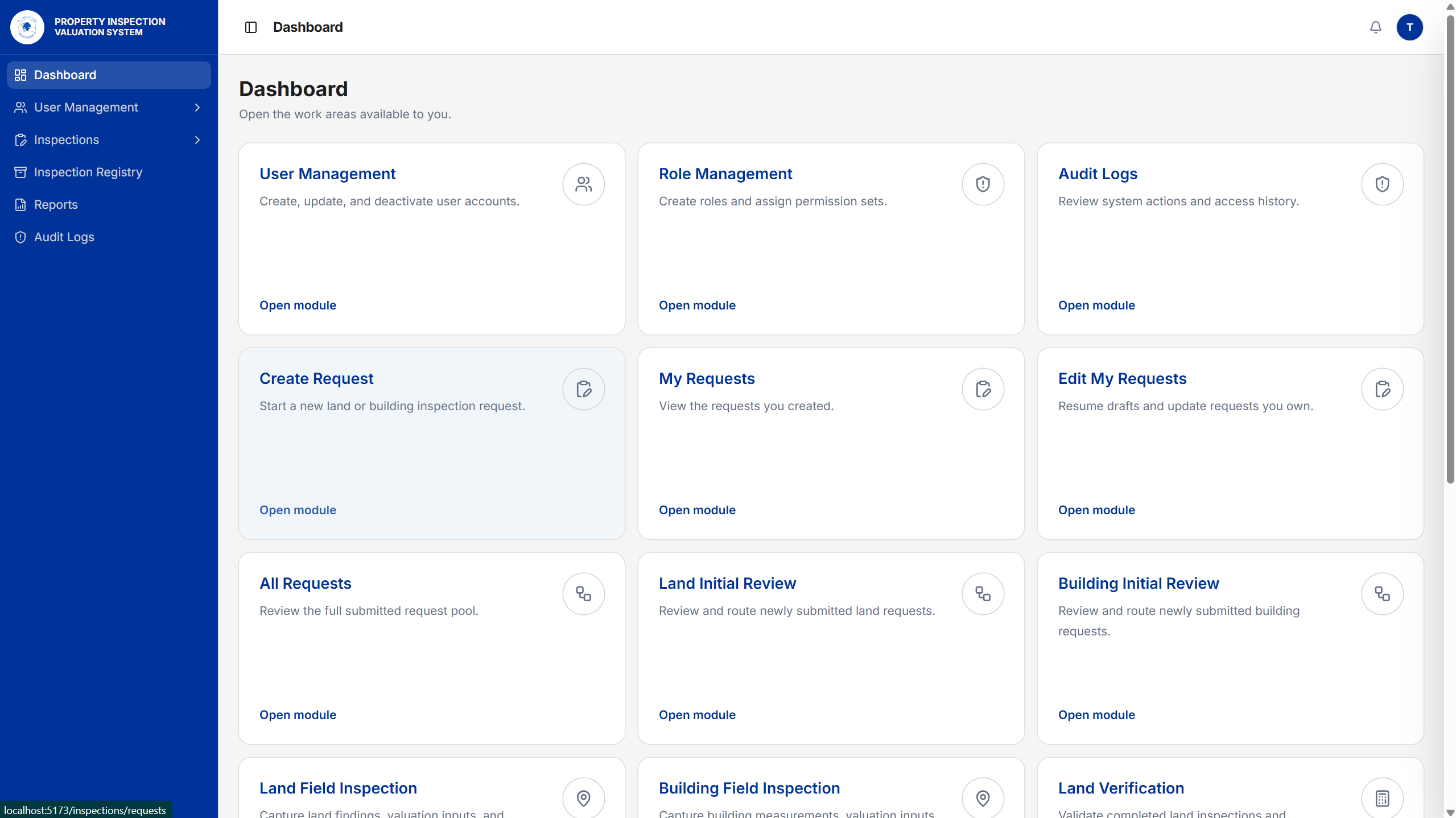
I led backend development of the Property Inspection & Valuation System for Bhutan Insurance Limited. The application connects land and building requests, technical assessments, valuation calculations, verification, approval, and reporting in one role-based workflow, keeping each decision connected to its supporting evidence.
- Client & programme
- Bhutan Insurance Limited (BIL), Thimphu
- My role
- Lead backend developer
- Collaboration
- BIL client project
- Project status
- Developed & delivered for operational use
The problem
Keep the property assessment and its decisions together.
A property inspection brings together owner information, land or building details, measurements, risk observations, supporting documents, and several levels of review. Each officer needs to know what has already been assessed, which evidence supports it, and what action is required next.
APIVS models that work as a connected business process for BIL. Separate land and building requests move through initial review, field inspection, verification, and final approval, with assigned tasks, stage remarks, correction paths, and a registry for finalized records.
My contribution
Build the backend around the inspection lifecycle.
As lead backend developer, I built REST APIs, authentication and authorization, business logic, and database operations using NestJS and PostgreSQL. My work covered inspection requests, officer assignments, multi-level review and approval, property valuation calculations, risk-assessment functionality, document and image handling, inspection history, and automated report generation.
I also deployed the application and supported environment configuration, system validation, testing, and delivery for operational use at BIL. The wider application includes a React interface and guided assessment forms; my primary responsibility was the backend that validates, stores, and coordinates those workflows.
The inspection workflow
Give every handoff an owner and a clear next action.
The application separates request creation from the four controlled task stages. An assigned officer accepts a task before editing or taking a workflow action. Land and building permissions determine who can perform each stage and which officers are eligible to receive the next assignment.
Create and submit
The creator records the owner, property identifiers, location, and supporting documents in a land or building request. Drafts can be reviewed before submission to an initial reviewer.
Review and assign
The initial reviewer checks completeness and assigns an eligible technical officer. Incomplete requests can return to the creator with feedback, while rejection ends the active workflow.
Inspect and assess
The field officer completes the property-specific assessment, records valuation inputs, and attaches evidence. Required fields and documents must be complete before the report is forwarded.
Verify the report
The verifying officer examines the assessment, valuation, documents, and remarks, then forwards the case or returns it for correction through a permitted earlier stage.
Approve and retain
The approving authority reviews the complete case and records the final decision. Approved records enter the inspection registry, with authorized access to the valuation certificate and supporting documents.
Assessments & valuation
Use different assessment models for land and buildings.
The inspection workspace guides officers through property-specific sections, with draft persistence, autosave feedback, and an explicit Save Progress action. Stage remarks and previous feedback remain available when work is returned, so corrections can be made in context.
Backend calculations use the assessment information to prepare a valuation for review. The result remains connected to the property record and supporting evidence as it moves through verification and approval.
- Land assessment
- Condition, utilities and access, observations, sketches, photographs, consent evidence, and valuation inputs are captured in a structured land assessment.
- Building assessment
- Construction details, measurements, layout sketches, adjoining structures, and risk observations support the building assessment and its reviewed valuation.
- Correction and review
- Validation messages identify incomplete fields, while permitted return paths preserve feedback between officers. A returned report can be corrected and resubmitted without losing its workflow history.
Engineering decisions
Coordinate the request, task, and history as one change.
The application combines a React frontend, a NestJS backend, and PostgreSQL. Clear responsibilities between the interface, business rules, and records help keep the workflow maintainable as requirements change.
Backend operations coordinate the request status, assigned work, and workflow history. Consistent updates help prevent conflicting handoffs and give officers a dependable view of the case's current state.
Background processing supports notifications and administrative record keeping. Users receive updates about assignments and returned work, with a history they can return to while completing their tasks.
Access & supporting evidence
Apply workflow permissions to the documents as well.
Authorized staff access the application through its account and permission model. Access to a case and its actions follows the user's responsibility and assigned work, helping each officer focus on the stages they are authorized to complete.
PDF and image evidence stays linked to the relevant inspection. Document handling validates supported uploads and provides controlled access to the files needed for assessment and review.
Viewing, updating, and exporting supporting documents follows the user's access and the workflow state. This keeps evidence available to the people reviewing the case throughout its lifecycle.
Reporting & traceability
Make completed cases and operational workload inspectable.
The inspection registry gives authorized users a searchable view of approved and rejected records. A case retains its request details, valuation, supporting documents, and workflow history, with approved valuation certificates and related downloads available where permitted.
Management Information System reports organize operational views into Overview, Workflow, Officers, Locations, Valuation, and Request. Filters apply to the displayed results and PDF or CSV exports, connecting the management view to the same inspection records used by the operational workflow.
- Workload and processing
- Request volumes, status distributions, trends, stage acceptance and processing times, and officer activity help staff review where work is concentrated.
- Locations and valuations
- Geographic summaries and land or building valuation totals provide different views of inspection activity, with filtered report exports for further analysis.
- History and accountability
- Request-specific workflow timelines preserve business-stage progression. Administrative audit records separately capture important application activity for authorized review.
Delivery & learning
Deliver the workflow with the foundations needed to operate it.
The project ran from August 2025 to June 2026. My delivery work included application deployment, environment configuration, system validation, and testing. The operational manual documents the complete user journey, from request creation and task acceptance to reports, administration, and support.
Delivery work included deployment preparation and checks for calculation behavior, application services, and selected workflow scenarios. Validation and user guidance supported the transition from implementation to operational use.
The project strengthened my experience in backend domain modeling, business workflows, controlled document handling, reporting, and deployment. Its central engineering lesson was that a reliable valuation system needs the calculation, supporting evidence, officer responsibility, and review history to remain connected throughout the case.